


In the United States, where the number of homeless seniors is rising, an NGO is providing shelter to the most vulnerable.
“Senior Cards.” Once a month, one of our journalists describes what aging looks like beyond our borders. In the United States, the risk of ending up on the streets increases with age. In Washington, the NGO Friendship Place offers a final home to these vulnerable elderly individuals.
By Clément Verstraete (Washington correspondent)
Published yesterday at 6:00 p.m. • 4-minute read
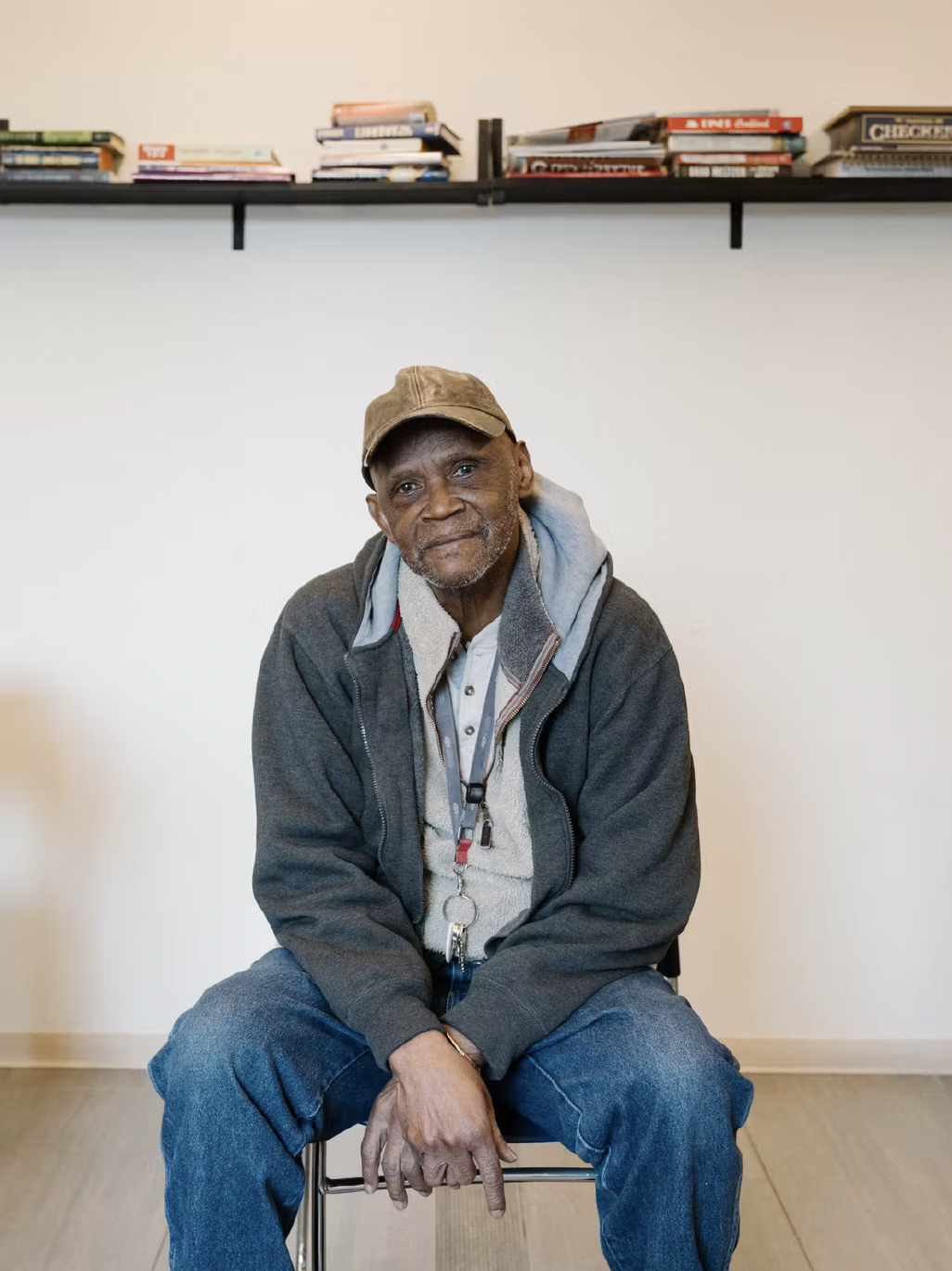 Michael Brown, 73, has been a resident free of charge since 2014 at La Casa, the building managed by the NGO Friendship Place, which provides housing for the homeless. In Washington, February 13, 2026. CAROLINE GUTMAN FOR “LE MONDE”
Brown suddenly lights up. At 73, Michael is the unofficial gardener and one of the 40 residents of La Casa, a building located in Columbia Heights, a rather working-class neighborhood of Washington, where many Latinos live. It is managed by the NGO Friendship Place, which provides housing for homeless people. Michael ended up on the streets at 58. Liver cancer, the death of his partner, his name not being on the lease… misfortunes followed one another like falling dominoes. “Ending up on the street happened that fast,” he says, snapping his fingers. Since 2014, he has found refuge at La Casa.
In the United States, the risk of becoming homeless increases with age. In January 2025, the official body United States Interagency Council on Homelessness estimated that more than 146,000 people over the age of 55 were homeless nationwide, out of a total of just over 771,000. These figures come from a point-in-time count, a census conducted on a single night, but specialists believe the real number would need to be nearly doubled to reflect reality.
In its annual report, the National Alliance to End Homelessness—a nonprofit organization that conducts research on homelessness—explains that seniors “are the fastest-growing group of homeless people in the United States.” By 2030, their numbers could be three times higher than in 2017. The causes are multiple and cumulative: worsening housing crisis, inflation, stagnation of wages among middle- and low-income households,…
“Seniors who end up on the streets often were unable to contribute to a retirement fund during their careers,” adds Jean-Michel Giraud, CEO of Friendship Place. “When they stop working, they have no savings, and the money they receive from Social Security—the agency that manages the public retirement system—is not enough to pay their rent.” In January, the average retirement pension in the United States was $2,071 (€1,754). In the American system, this money is only supposed to account for one-third of retirees’ total income, the rest coming—if available—from personal savings, employer-sponsored plans, and private pensions.
Having arrived in the United States in 2000, Abou Bamba worked as an electrician in New York and several East Coast states. A blood infection forced this 61-year-old Malian man to have his right leg amputated. Unable to earn a living, he ended up homeless for several months—a period he would like to erase from his memory. A resident of La Casa since 2022, he receives help from a caregiver in his daily life. “The people at Friendship Place listen to my needs. They help me get to the hospital and with food,” he explains in a faint voice. In his L-shaped room, adapted for people with reduced mobility, two braces are leaning against the wall. Abou Bamba practices walking with them and hopes to return to work once he is more comfortable moving around.

Abou Bamba, a 61-year-old Malian, lived on the streets for several months after the amputation of his right leg. He found refuge at La Casa in Washington in 2022. Here, in his room adapted to his disability, February 13, 2026. CAROLINE GUTMAN FOR “LE MONDE”
“Making sure they feel good”
In addition to La Casa, where residents are housed free of charge, and certain individual apartments where tenants pay a modest rent equal to 30% of their income, Friendship Place also offers a shared housing system, where people in difficulty only have to pay for a room.
“We try to prevent people from being forced into nursing homes,” continues Jean-Michel Giraud. These facilities, whose quality varies widely, are not very popular among Americans, who prefer senior residences, which are much more expensive. “It’s a medical environment and more hierarchical, which can be difficult to cope with. People living there, for example, are only entitled to €50 in pocket money per month. We prioritize aging in place, so that people can stay with us as long as possible,” continues the 64-year-old Frenchman, who was made a Knight of the Legion of Honor in 2025 for his commitment. “At La Casa, we welcome the most vulnerable people in the system—those who need psychiatric or medical help, who have addictions or disabilities. First and foremost, we want to make sure people feel well, because when someone has experienced homelessness for a long time, the end of life can come very quickly.”
Still, sufficient housing must be available. It took a long time for La Casa to open its doors in 2014. “It took three years for the project to come to fruition because the building’s neighbors were really hostile to the presence of homeless people in their neighborhood,” recalls Alan Banks, 67, now an employee of Friendship Place after being homeless for six years until 2010. “They didn’t want them there, thought it would lower their property values and cause all kinds of problems.”

The entrance to La Casa, the building managed by the NGO Friendship Place, which houses elderly homeless people, in the Columbia Heights neighborhood of Washington, February 18, 2026. CAROLINE GUTMAN FOR “LE MONDE”
None of that happened. From the outside, La Casa—a municipal building managed by Friendship Place—looks like an ordinary residential building, and its residents, aware of their good fortune, keep a low profile. Abou Bamba spends a lot of time in his apartment, while Michael Brown, who grew up on a farm, prefers to offer gardening services in the neighborhood.
Both men say they are “loners” and “don’t really have friends” within La Casa—a mistrust inherited from their time in homeless shelters. “You have to be on guard all the time,” recalls Michael Brown. “There’s nowhere to store your belongings. You sleep with your shoes on your chest. Those places were too rough for me.”
Last year, Friendship Place helped 5,443 people of all ages. Some pass through, others have no plans to leave. Michael Brown belongs to the second group; as soon as the weather allows, he plans to plant green tomatoes on the terrace so he can make fried green tomatoes—his famous green tomato fritters.
Clément Verstraete (Washington correspondent)

